How Do You Rehearse a Landing on Titan?
NASA's Dragonfly rotorcraft found a safe landing site on Titan and came down. It all happened in a real-time simulation on Earth.

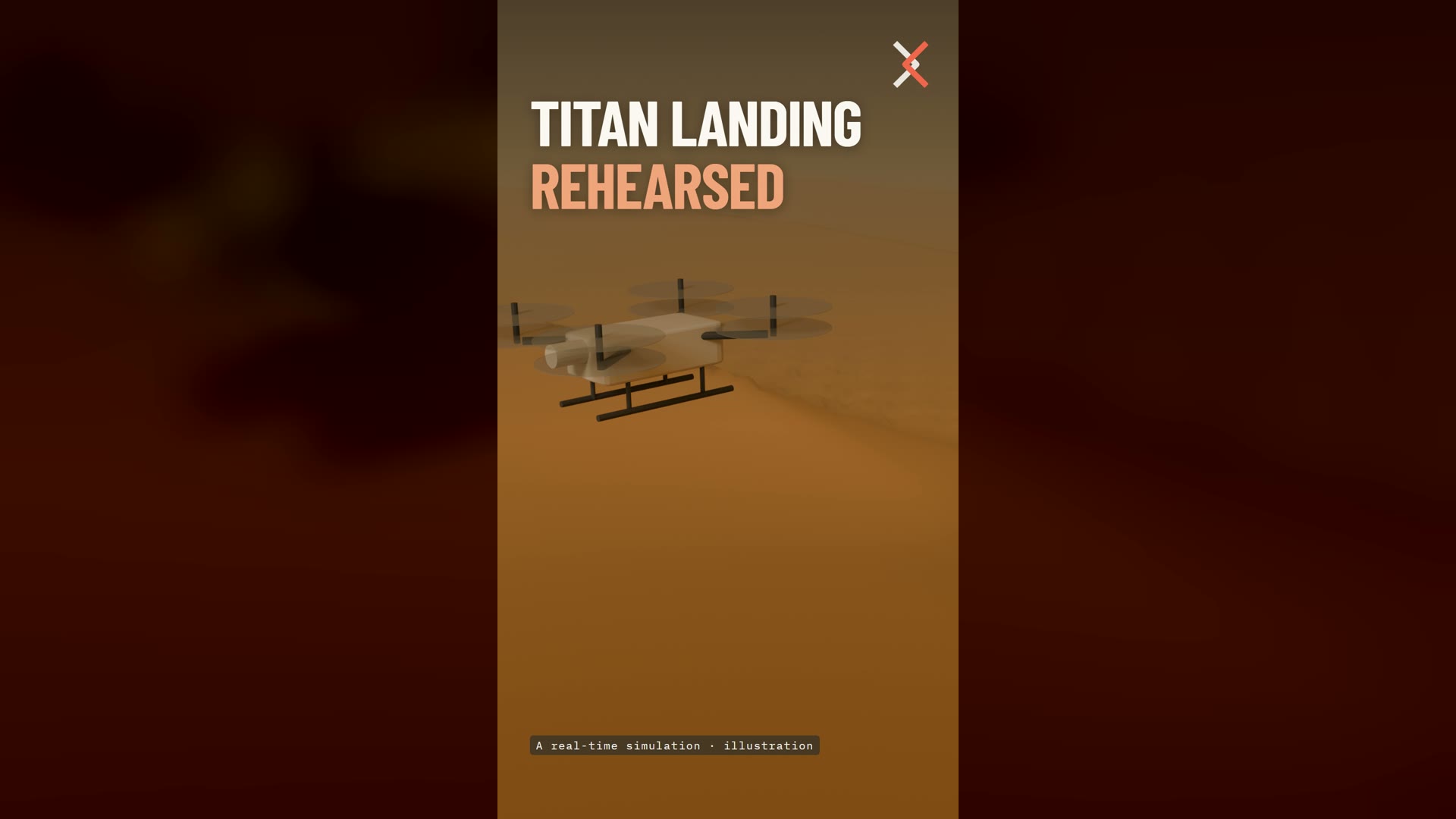
NASA's Dragonfly rotorcraft has flown over the dunes of Saturn's moon Titan and found a safe place to land. It never left Earth. The flight was a real-time computer simulation.
What happened
On 23 October 2026, NASA reported that Dragonfly had completed its first simulated flight. The test ran in real time on flight-like avionics, on a computer testbed at the Johns Hopkins Applied Physics Laboratory (APL) in Laurel, Maryland. NASA did not publish the date of the test itself.[1]
In the simulation, the rotorcraft sped over Titan's sand dunes on its own, looking for a safe place to land. NASA says it "traveled over a safe landing site, circled back, and began its final descent."[1]
Why rehearse on Earth
At Titan, Dragonfly "will have to fly without real-time help from Earth," according to NASA. Every flight decision, including where to land, has to be made on board.[1]
Our readThat is why it matters to test the software early. Once the craft is at Titan, nobody on Earth can step in during a landing. The time to check its choices is before launch.[1]
How the fake Titan worked
The flight software was fed a simulated Titan. It got data from simulated navigation cameras, motion sensors called IMUs, and lidar. The camera images were rendered in roughly 20 to 70 milliseconds, the same as the cameras' real exposure times.[1]
Lidar is the sensor that judges the ground. It measures the terrain's altitude and slope and identifies hazards, so the software can tell where landing is safe.[1]
A testbed is a set of computers built to behave like the spacecraft's own. It is not the spacecraft.
Why it matters
NASA describes the next steps as plans. The team intends to run the first flight on Dragonfly's actual flight system instead of a testbed, and to deliberately introduce faults.[1]
NASA plans to launch Dragonfly no earlier than 2028, with arrival at Titan planned for 2034.[1][2][3]
Our readIn our reading, injecting faults is how the team will learn what the software does when something goes wrong, not just when everything works.[1]
What's confirmed and what isn't
NASA reports that the simulated flight was completed in real time on a flight-like testbed at APL. It also reports that the software passed a safe site, circled back and descended.[1]
Nothing has flown on Titan. This was a rehearsal on Earth computers, not on the spacecraft. The tests on the real flight system and the fault tests are still plans, as are the launch and arrival dates. Every detail here comes from NASA and APL. We found no independent coverage.
- Not claimedThat anything has flown on Titan.
- Not claimedThat the simulated terrain is a named Titan region such as Selk or Ahmakiq Undae.
- Not claimedThat this was the "most comprehensive test to date" (NASA's description, not repeated here).
- Not claimedAny altitude, speed or signal-delay figure.
- Not claimedThe date the test took place; 23 October 2026 is the date NASA reported it.
- Not claimedIndependent confirmation; all sources are NASA or APL.
- Not claimedAny NASA or APL endorsement.
Sources
- NASA Science — NASA's Dragonfly Completes First Simulated Flight, 2026-10-23Primary
- NASA Science — Dragonfly mission pagePrimary
- NASA Science — NASA's Dragonfly Gets Wired Up While Titan Landing Area Is Named, 2026-09-02Primary
7 claims checked against these sources; 0 confirmed.
Spot an error? Request a correction.
Video transcript
NASA's Dragonfly just flew over Titan's dunes and picked its own landing spot.
But it never left Earth. It was a real-time simulation, on flight-like computers at Johns Hopkins APL in Maryland.
The software was fed a fake Titan: terrain for its lidar, and camera views drawn in 20–70 milliseconds, matching real exposure times.
Lidar measures the ground's slope and spots hazards. Dragonfly passed over a safe site, circled back, and came down.
At Titan, it must do this with no real-time help from Earth. Every decision happens on board.
This was a testbed, not the spacecraft. Next, the team plans to repeat it on Dragonfly's own flight system, and to inject deliberate faults.
Launch is planned for no earlier than 2028. Its first landing is already being rehearsed, millisecond by millisecond.
Production note: The video's Titan landscape, rotorcraft, testbed and diagrams are original illustrations of the simulation, labelled as such. The only real image is Cassini's view of Titan from 16 April 2005 (NASA/JPL/Space Science Institute), shown unaltered. The narration uses a synthetic preset voice.
What else changed
 Space & Science2 min readSpace & ScienceOne Particle of Antimatter, Held for MonthsPhysicists at Northwestern University have held a single positron, the electron's antimatter twin, in a magnetic trap for months. They can now watch it climb one energy step at a time.Read story
 Space & Science2 min readSpace & ScienceMoon Trash Could Become Tomorrow's Spare PartsAn MIT student team won first prize in NASA's LunaRecycle Challenge with a system that grinds discarded packaging and molds it into composite parts. The foam usually thrown out becomes part of the material.Read story
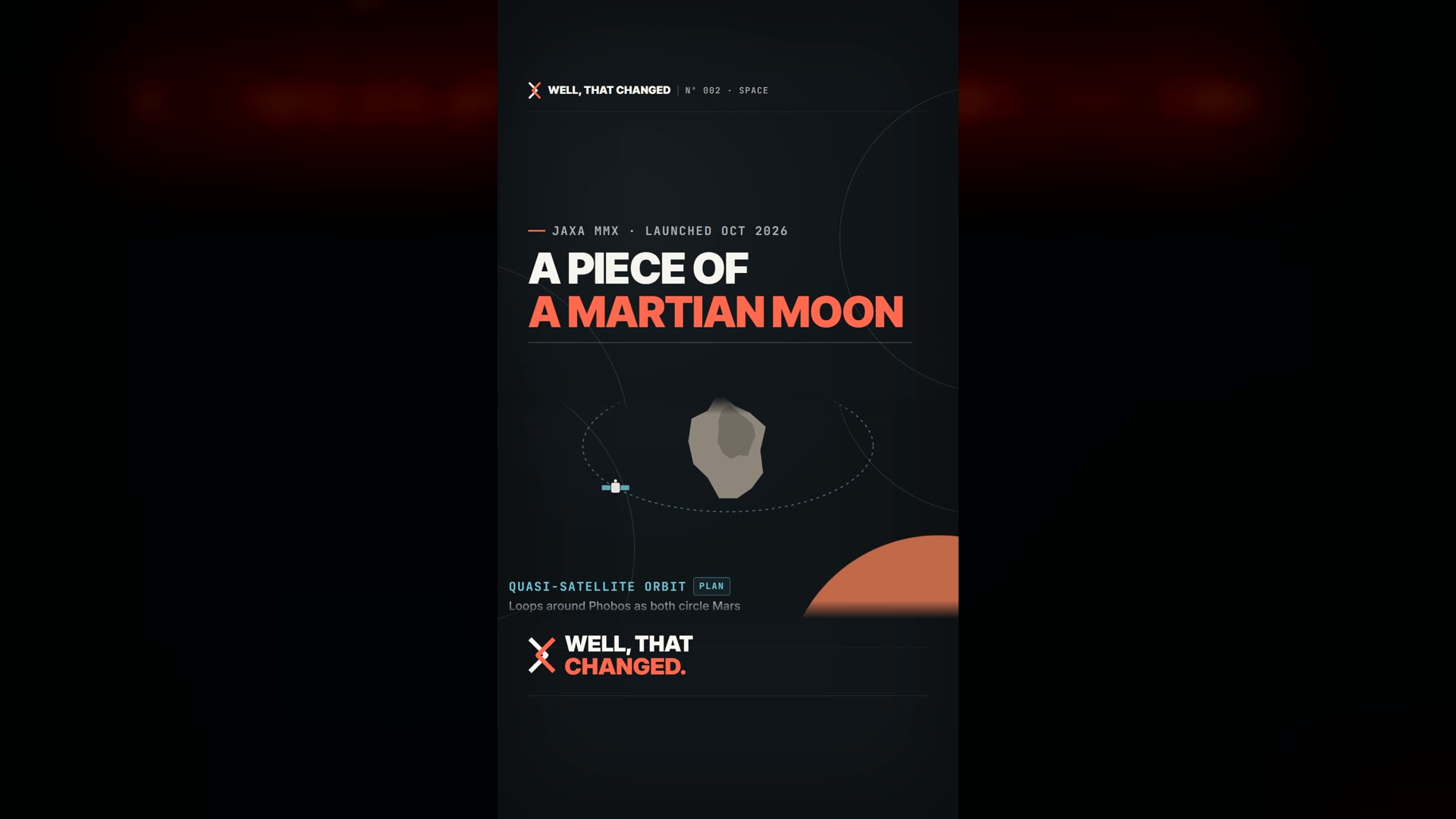 Space & Science2 min readSpace & ScienceJapan Is Going to Mars's Moon Phobos — and Plans to Bring a Piece BackJAXA's MMX spacecraft has launched toward Phobos, one of Mars's two moons. The plan is to bring at least 10 grams of it back to Earth by 2031.Read story